
Remnants of Gold Full Review: A Deadly Quest For Fools Gold at the End of the Mirage
Updated: 1 day ago
An existential examination of idealism, conviction, and morality seamlessly embedded into a gritty Wuxia that packs a punch by unpacking human nature.

Title: | Remnants of Gold (2022) |
Platform: | WeTV, iflix |
Episode Count: | 13 |
Genre: | Wuxia |
MDL Rating (out of 10): | |
Douban Rating (out of 10) | 6.7 |
Parental Guidance Rating: | TV-16: Bloody violence, much death. Doesn't have an official rating, but I'd say it's between TV-16 and MA Lite. |
Starring:  | Xin Zhie Lei as Zhang Lu Yao (Joy of LIfe) Ying Fang as Pu Ying (The Long River) Gao Wei Guang as Ban Cha (Eternal Love) Ken Wu as Xiao Fang (Tigers Sniff the Rose) Bu Guan Jin as Ping Ping (Link Click) Chen Kuni as You Hou (Rise of the Phoenixes) Yin Zhu Shen as Ha Bing Zhong (Moonlit Reunion) Li Yi Xiang as Ba Na (Twelve Letters) Lian Yi Ming as Tie Fu Tu (Side Story of Fox Volant) Hong Yang as Cononer Chi (The Heir) |
Cast From Left to Right: #XinZhiLei, #YinFang, #ChenKun, #GaoWeiGuang, #KenWu
Synopsis:
The tale of 300,000 taels of gold rumored to be hidden in the desert, guarded by fearsome warriors reaches the ears of desperate men who hatch a deadly plot: Poison the 27 members of an escort agency to lure out their last surviving kinswoman, a master of poison, to help them track down the lost gold. But these schemers did not see Zhang Lu Yao coming, nor did they anticipate her mission for revenge, aided a bumbling Embroidered Guard from the capital. Together the two team up to uncover the truth behind the murder, putting themselves directly in the crosshairs of those protecting and seeking the gold, as all parties are forced to question how far they are willing to go to get what they truly desire.
Character Names From Left to Right: Zhang Lu Yao, Pu Ying, Yu Hou, Ban Cha, Xiao Fang, and Ping Ping
Isn’t it good enough to just be alive?
Non Spoiler Thoughts:
So... I went into Remnants of Gold expecting a popcorn watch with handsome beared men flying through the air on wires doing some nifty Jedi moves, which did happen. There were indeed very handsome men and some of them did fly around. However, I didn't expect the existential interrogation of morals in a thematic cross examination of how people live and why. The drama packs a punch in terms of martial arts, gritty cinematography, and all star cast, but it's what it unpacks that makes it so remarkable.
Remnants of Gold deconstructs idealism, conviction and belief down to its skeletal facade in a landscape appropriately bereft of human efficacy. Each character struggles to overcome external forces, and wrestles with paradoxical humanity that leaves them weak and powerless in pursuit of their different goals: be it justice, respect, freedom, or wealth. The narrative is a cautionary tale on how adherence can make the ends justify any means, and can turn good men into monsters. One must guard against ideals, but one cannot live a human life without them.
The drama uses the gold as a mirror to strip away each characters pretenses to reveal who they really are and how it conflicts with who they claim to be. The gold is a deity more powerful than the lies they tell themselves, and though fools gold it may be, nothing is more foolish than the people who seek it.
Remnants of Gold was shot on location, with practical stuntwork that wasn't as impressive as I thought it would be, but each fight scene had an intention and was used to further the story and character development, so it gets a pass. The drama is dirty and bloody in a non-idol fashion, and the tone reminded me of the 2026 film The Odyssey in terms of its mythic strangeness and other worldly environment that no man can outrun. Plus, the General and his Guards had a similar vibe to to that giant dude in the black armor from the film (but the armor was much better here than The Odyssey lol). The story takes off immediately and wastes no time with a tight 13 episode span that felt like the Westerns I used to watch as a child. But better!
The Source Material:
Remnants of Gold is so loosely based on the famed novel Da Di Fei Ying by Gu Long, I would say it's more inspired by, than an actual adaptation. The novel gave birth a few live action screen adaptations, such as Land of The Condors and Big Land, Flying Eagle which is described at:
Big Land, Flying Eagles is a spaghetti western-sequel desert intrigue film set on the Mongolian-Chinese border. Xiao Fung, a notable swordsman, has killed the son of a local warlord, Lee San, and the 3,000,000 tael that Lee’s son was transporting, now seems to have gone missing. Xiao Fung is now marked for death by Lee San, but finds protection from “Killer Eagle” another swordsman of great repute, and a band of nomadic Mongolian traders. Nevertheless, Lee sends killers of unusual backgrounds, including Buddhist monks, to hunt Xiao Fung down, while Xiao Fung seems curiously preoccupied with a woman who’s embroiled in unstated conflicts with practically everybody. @MDL
___________Beware Mateys: There be Spoilers ahead!_______________

Who Do You Think You Are?
Each character on the trail for the 300,000 taels must face themselves and their confront their conflicting desires which the hunt for treasure only magnifies. Each character holds to a principle that is met with emerging dissonance, forcing them to let go of their convictions and give into their contrary wants, or to stay true to the perilous course.
Zhang Lu Yao: The Victim and The Avenger
Principle: Justice
Conflicting Desire: Revenge
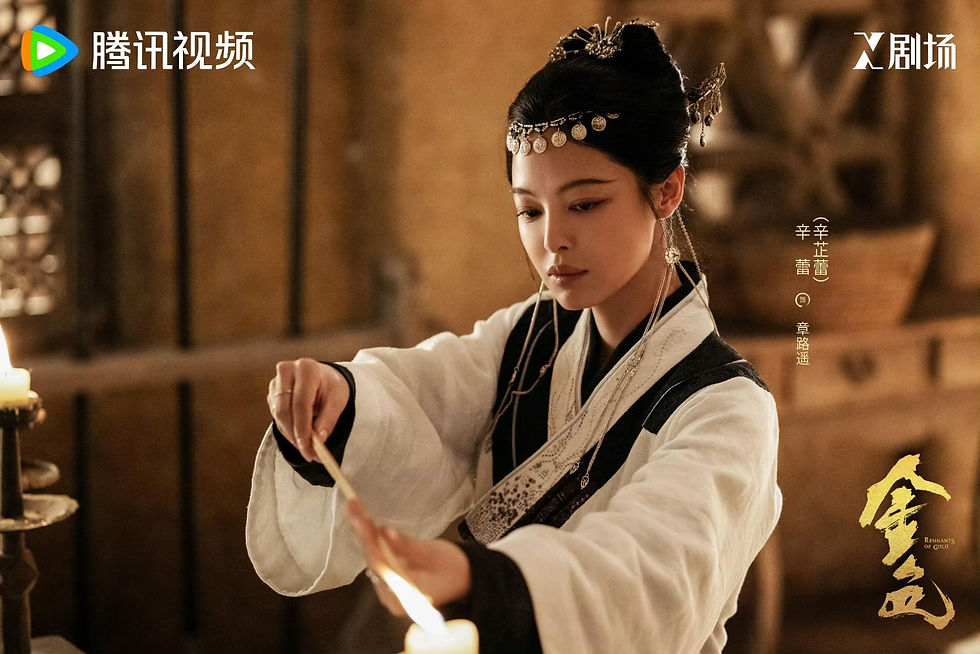
Zhang Lu Yao (and Xin Zhi Lei) was so cool! She is the textbook definition of what the kids would call a stone cold baddie, and quickly became my new favorite C-drama protagonist. She is calm, elegant, and collected, but it’s her ability to empathize that draws in her helper heroes. She has a history steeped in trauma after being used by her “husband” in Shu to test poisons, and escapes (I’m assuming) after learning that her entire clan had been annihilated. But even before the driving trauma, ZLY bore the simple difficulty of being a woman in the Ming Dynasty who, like many women, wasn’t treated like a family member or even as a human. She often refers to her ex-husband as translucent (I would call him a jump scare), but after years of being corroded by the people she loved and hated, she wound up becoming translucent as well, seemingly skirting over emotions and the world around her. And once her last tether, PingPing, perishes at the well, she is ready to float away.
Throughout the drama, she wears white that only becomes dirty when she feels a strong emotion, but for the most part, she is pristine and above it all. As she says, her mind is as still as water. The white is not only an indicator of purity, but of death, as she has “died a 100 times” and therefore isn’t really living, though alive. But underneath that white jacket, she wears a black robe, which to me is a visual tell, suggesting that though she appears collected on the surface, if the white hand of justice can't resolve the case, her heart won't be settled until she takes revenge. Her values and morals point her towards justice, but after years of being let down by those in power (i.e. husband, father, the law), she doesn’t actually expect its achievability, leaving her no choice but to take matters into her own hands.
And what is the difference between justice and revenge in this case? Well, as the saying goes: Taking revenge is like drinking poison and waiting for the other person to die. Justice is measured and definable, and often something you can’t get or name yourself. On the flip side, revenge often costs as much as it takes; giving a life for a life already taken. This leads her to make the RECKLESS decision to poison Ha Bing Zhong with the voodoo grass, but her morality wins in the end, and she gives her last remaining antidote to Pu Ying, who saves her from giving in to her dark thoughts. He stops her desire from tainting her principles.
Throughout the drama, because I am the way I am and I do love a romance (though this is a non-romance), I kept going back and forth on who I thought should be ZLY’s beau, and to my surprise, I landed on Pu Ying. My reasoning is thus: He’s the one who constantly saves her. She reminds him repeatedly that she doesn't know what she’d do if he hadn’t come, as her only option would have been to go full sith lord without the law on her side. He constantly showed up in the nick of time and held onto his morals by the seat of his pants, and never gave up on her. He was a little annoying, but he was a real one. Yu Hou was her kindred spirit and Ban Cha was her friend, and both saved her in body, but Pu Ying was able to save her mind and allowed her to stay who she was: A good person. It's not for nothing that he told her, "As long as I'm here, you'll have a future."
Pu Ying: The Righteous Rookie
Principle: Authority of Law
Desire: Respect and Justice
Pu Ying was an arrogant, bumbling, teenage tantrum just waiting to happen.
He pointed excessively and I found myself yelling “Use your words” at the TV. He did indeed have the vibes of “Wait, until my father hears about this”. A Rookie Embroidered Uniform Guard of the Seventh Rank, Pu Ying is used to a clear cut social hierarchy, but he soon finds the truth of the saying: Heaven is high, and the emperor is far away. World order as he knows it doesn’t exist in the desert, and even a coroner, who would have been despised and looked down on in the capital, dares to look down on him. The authority he believes in just doesn’t exist out in this wasteland, but as the drama demonstrates, sometimes believing in something can make it real.
This guy wants respect the way Zuko (From AtLAB) wanted his honor, but out in the wilderness respect is earned, not just bestowed by a rank. His constant demands of the respect "owed" to him makes him fall flat on his face (literally) several times, and it redefines authority for him. But the biggest difference in his case, is that his principle doesn't necessarily conflict with his desires. The authority system is broken and justice for ZLY can't be obtained, it's a cause and effect that is algined with his beliefs. But his is an interesting situation in that his notion of what authority is and how respect is gained is reframed. One now doesn't always lead to another. Even though Pu Ying is a bit of a square, he's never tempted from his principle and guards his desire within his existing framework in stark contrast to Ban Cha and Yu Hou. Once the authority of law is restored and "justice" is gained, it feels anti-climactic, because Pu Ying has evolved, which the other characters never managed successfully.
He also gained a new principle, or conviction at the begining of the story: Our Queen, ZLY. As he says to Ha Bing Zhong, he might have been tempted and swayed by hardships to take the wealth if he hadn’t been saved by ZLY, who appeared as a deity to him. She becomes the new "authority" and her constantly reminding him that he was a “good” man is what let him remain one. She believed in him and he believed in her. He found something to replace the sole dedication of his principle, and something that mattered more than his desires. (Though he constantly wanted to gain ZLY’s respect, and became angry when she made moves to protect him.) He’s the other side of the Yu Hou coin, as he is now her “follower”, and I’d be curious to see if he would go back to the capital if the drama had continued. I do think he would have.
Ban Cha: The Honest Liar
Principle: Keeping to his word as a Guardian
Conflicting Desire: Freedom and peace
Ban Cha was a fun, jolly character. I wouldn’t mind if they dropped him into every Wuxia going forward. He’s been a Guardian of the Gold for thirty years and you can tell he’s tired of that life, but he’s a man who keeps to his word and he gave it to the chancellor that he’d guard the gold. But in his willingness to help out Zhang Lu Yao and keep mum about Ba Na hiding his son from the other guardians, you can see the cracks in that resolve.
The principle of honesty is hilariously made impossible by Ban Cha’s own desire for freedom and peace, and the external circumstances that force his hand. He told Ba Na that he would bring the wine, but gave it to ZLY, not because he wanted money, but I think because he found friendship in someone who was so free in her heart. He agrees to spare Fang, but kills him to save Ba Na's son, and finally, he turns back from his mission of protecting the gold to spare ZLY’s corpse from a grisly fate and give her human dignity, in the ultimate act of preserving peace and freedom that would never belong to him.
At one point, he admitted that of course he lies, but these lies often bring peace, which is what he sought the most. In the end, he let his conflicting desires overrule counterfeit convictions, bad sadly to his demise.
Yu Hou: A Sheep and a Shepherd

Principle: Follow the General
Conflicting Desire: Greed/Freedom
First off, shout out to Chen Kun, who wins me over every time regardless of the morality of his character. He played Hou, a good man turning bad, with so much emotional depth and nuance, you could see on his face that he was struggling with his decisions. I loved his relationship with Zhang Lu Yao, who he felt kinship with, as she was the embodiment of the peace of mind he so desperately wanted. The man was torn up as his religious devotion to the general and upholding military order was in opposition with his true desire: Leave the desert and get rich.
He was greedy in a really interesting way. He had fine things and played the gentleman in private, not because he was a secret fop at heart, but because he wanted to be a different person. He was exhausted by his devotion and wanted a change of scenery, which isn’t a crime. But he let despair and his inner conflict take over, and became greedy, which by definition is an intense, selfish desire to possess more of something than one needs or deserves. The man didn’t need that much gold. Truly. But it was never about the gold, it was about the freedom— and the control. For him, who had lived his life in a sandy cage, there was no such thing as too much freedom, and without principles to reign him in he made devastating mistakes. Yu Hou is a tragic case: his principles led him to sit back while terrible crimes were comitted, while their restraining abscence let his desires ruin him.
There was such a good scene when ZLY was talking to Yu Hou through a window, and the bars made it look like he was in a prison as it perfectly reflects his state of mind. The man is suffocated.
Yu Hou wants to be the God in his own life, and it’s only when he sees the destruction he’s caused with the death of his “follower”, Xiao Fang, that he snaps back to reality and tries to make it right. I’m glad they gave him a redemption arc because his desire wasn’t wrong, nor was the shirking of his devotion to the General necessarily, but it goes to show how important it is to make sure your values and desires align. It’s an interesting thought experiment on how ideals can shape people and whether or not people can live without them, and acts a warning of the dangers of idolizing others.
Xiao Fang: The Blind Following the Blind
Principle: Blind Obedience
Conflicting Desire: Personal beliefs/agency
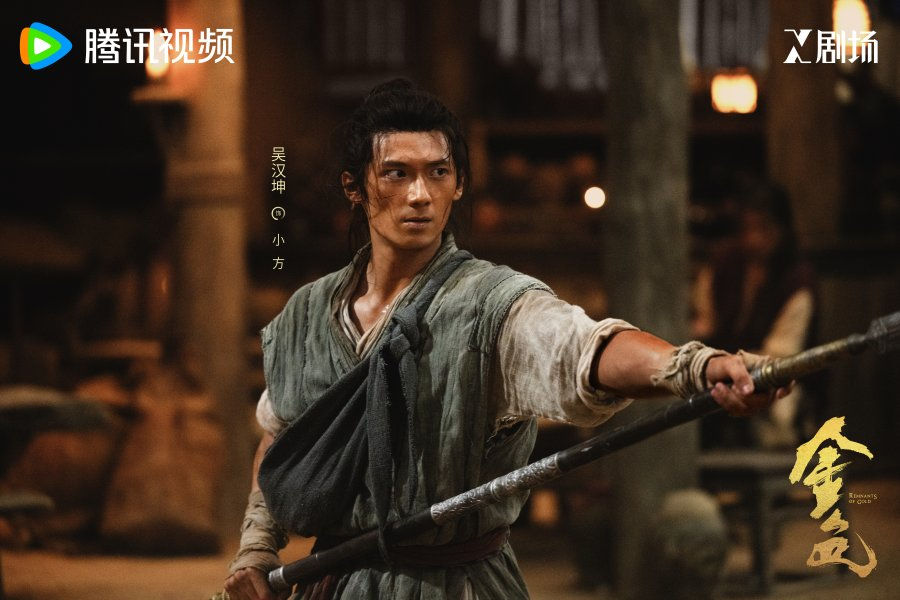
Peace and blessings, but I didn’t vibe with Fang. But his character was necessary, as he represents the younger version of Yu Hou, with a matching cheek scar, deep in the throes of devotion, and his story serves as an excellent warning of blind obedience. He followed Yu Hou and the General without question, and treated them as Gods rather than people, but when he notices their bad behavior, he can’t help but be conflicted. His emotional outbursts were hard to watch as his heroes came crashing down, but rather than accepting reality, he fought against it to his demise. Instead of forming a new principle to align with his desire, he threw away his life and what he really wanted for the sake of an illusion. Blind obedience and personal agency cannot coexist, and so he could not live.
He also looks IDENTICAL to Leo Wu (Ling Bu Yi from Love Like the Galaxy).
How Did it End?
Remnants of Gold gave us a two-in-one ending:
Possibility One: Zhang Lu Yao is believed to be dead after battling it out with Pu Ying and Ha Bing Zhong at the military post. Pu Ying and the coroner escort her to the Wusa Sea and along the way, pass her ex-husband who was mortally wounded by the desert's number 1 G, Ban Cha, and with his death and the ringing of her fancy bell, her mind is calmed and her soul is recalled to her body. With the fulfillment of her revenge against those who wronged her, she no longer has to live as the living dead and can start life anew. A true resurrection. She and Officer Pu then ride off into the sunset of the Wusa sea, happy as clams.
Possibility Two: So... bestie is dead. Hear me out: Girlie pop gets absolutely trashed at the military post, and it's implied, that like Ban Cha who never lies, she's been untruthful about her own catchphrase and she was never immune to all poisons from the get go. Officer Pu has the coroner confirm she's dead, and she is. Wanting to fulfill her last wish, he and the coroner escort her to the Wusa sea and as she passes her chopped ex, she seemingly awakes. Except she's still dead, sorry fam. But how could this be? See, as this occured, the group approached the Nether Sea where the living and the dead intermingle, and with the passing of her aforementioned busted spouse, her final wish and hope for revenge in the land of the living has been fulfilled, and her spirit can finally let go. Hearing movement, the coroner and Officer Pu investigate, but Pu tells the coroner not to look and Pu opens the window himself. When he sees his erstwhile dead BFF sitting up, he says "it's like a dream." My interpretation of this is that Officer Pu finally falls victim to the "fools gold" and fully embraces the lies that validate his "principle". Like Yu Hou and his General, Pu saw Zhang Lu Yao as a diety and dieties don't die. The "two" head off to the Wusa Sea, which is actually just a dessert, and Pu imagines her smiling as she has finally entered Heaven. We glimpse the gold in the sand that fades away as quickly as it appears, like a mirage, symbolizing that to Pu, ZLY back from the dead is the "reward" he is willing to believe in for the sake of his "principle", just as Tie Fu Tu went to the military post for the treasure, although he knew it couldn't possibly be there.

Now, I prefer the first possibility for obvious reasons, but it goes to show how layered the writing is. However, this interpretive plotpoint is what's hard about Wuxias versus other fantasy genres. It's hard to know the scope of how "fantasy" the plot is allowed to be. Can Zhang Lu Yao come back to life? Can there be an oasis in the dessert? If you can make power ranger attack animals out of sand, wouldn't resurrection be within the perimeters? My lack of fantasy boundary expectations could be due to my newness to the genre, but lately, dramas keep playing fast and loose with the line between what is possible with Xianxia (High Fantasy) and reality. It really is a mystery.
The Remnants After the credits rolled, the central question of the drama remained alive and unwell in my brain: Isn't it good enough to just be alive? And like the open ending, the drama doesn't have a clear cut awnser: It's both yes and no. The gold and the illusory ideals aren't worth dying for, but living a life just for sake of living without ideals can lead people to become a monster like Tang Zheng. Perhaps the trick is to check and balance yours desires with your beliefs; One cannot live peacefully if your ideals conflict with your true desires, which requires reframing of either one, or destruction.
The other side of that gold tael is answered by Zhang Lu Yao: Good people should live long lives. It's not just about existing, but about having something to exist for and believe in. It's not enough just to be a person, life should be spent on being a good person. This is an idealism that she holds to and if the literal interpretation of the ending is to be taken at face value, it's one that Pu Ying fulfilled and thus he's the one who reveals the gold, or "reward" as he slides down the sand dune. The desire to live, for many, is conditional and we create beliefs that fulfill those requirements, but when we no longer feel that they serve us, is it appropriate to cast them off? In such cases, is the person wrong or the belief? It's a labyrinth of existential crisis I was not expecting to enter when I popped my popcorn and turned on my evening show.
Overall, I really enjoyed Remnants of Gold. It was thoughtful, flashy, and had a host of complex, formidable characters that kept me on the edge of my seat and had me googling therapists. As for my take on it all: It's good to live, but it's important to live as good person. Reexamining beliefs, resisting despair, and having convictions is a recipe for a life worth treasuring, and if that's fools gold, call me a fool.


RBTS Overall Rating: 9.1/10 Stars- I Recommend! | ||
Story: | 9 | Some of the themes could have been sharper, but the narrative felt mythic and weighty. And most importantly, interesting. |
Acting: | 10 | I wish to see Chen Kun and Xin Zhi Lei in all of my shows. And I liked Gao Wei Guang's acting for once! |
Production Quality: | 8.5 | The cinematography and sets were bomb, but the I wasn't wowed by the stunts. |
Ending: | 8.5 | Threw me for a loop, but it weirdly left me feeling hopeful |
Enjoyability: | 9.5 | I found it compelling. Didn't skip once! |
Trailer:
Director: #ZhangShengFu
Screenwriter: #XuBing (The Legend of Heroes, Fearless Blood, New World)
*Disclaimer: I do not own any of the images used on this blog. All images belong to their respective copyright holders and are used for commentary and review purposes. All reviews, opinions, and statements expressed on this blog are my own and are intended for entertainment and informational purposes only. They reflect my personal thoughts and interpretations and should not be considered as factual.


Comments