
This Thriving Land: Dropped Drama Diaries
Updated: Sep 23

Title: | This Thriving Land (2025) |
Platform: | iQIYI |
MDL & Douban Rating: | 8.2 & 7.2 |
Genre: | Period (Republican) Domestic |
Episode Count: | 36 |
Last Episode Watched: | 15 |
Parental Guidance Rating: | PG: Brief side profile of child defecating in ep 1, a fade to black scene, assault referenced. DNF'd at 15, but I know there is violence and blood later on (obv. due to the time period). TV-16 is probably a more accurate rating. |
Starring: | Yang Mi (Eternal Love) Ou Hao (The Way You Come Back) Ni Da Hong (Swords into Plowshares) Qin Hai Lu (The Lead) Xing Fei (Lost Track of Time) Zhang Tan Yang (Love Like the Galaxy) |
Cast From Left to Right: #YangMi, #QinHaiLu, #XingFei, #LangYingYing, #ChiPeng
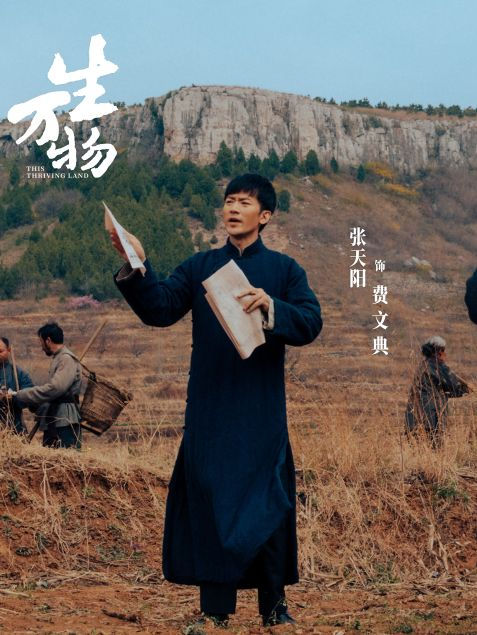
Cast From Left to Right: #OuHao, #NiDaHong, #ZhangTianYang, #PatrickZhang, #LinYongJian
Synopsis:
Ning Xiu Xiu, the daughter of the richest man in Tianniu Temple Village, was kidnapped by bandits on her wedding day. Her father, Ning Xue Xiang, was reluctant to sell his land to redeem her, so he married her sister to her childhood sweetheart, Fei Wen Dian. Xiu Xiu decisively severed her relationship with her father, married a farmer, learned to do farm work, and gradually understood the significance of land to farmers. During the two decades of hardships and legendary events, Xiu Xiu, Inspired by the revolutionary ideas of Du Chun Lin and others, uses the knowledge she learned to help her neighbors and lead the women in the village to get rid of the shackles of feudal ideas. @MDL
"What brings forth all things in this thriving land is neither heaven nor earth; it is humanity’s undying hope, unbending knees, and unbreakable spirit."
Non-Spoiler Thoughts:
This Thriving Land is a grounded republican period drama, following two sisters who just cannot catch a break, along with their Ebenezer Scrooge father who is just the worst, and needs to clear out those sinuses.
The drama takes place from 1926 to1944, and is essentially the poster child for the Communist led land reformation that transformed the social and economic order during the period. The first rumblings of change surfaced in 1928 when Deng Zihui began land reformation experiments, starting with a bottom up policy that eventually led to the seizure of land belonging to the "enemies of progress."
"All lands belonging to feudal landlords, local bullies and evil gentry, warlords, bureaucrats, and other large private landlords, irrespective of whether they work the lands themselves or rent them out, shall be confiscated without compensation. The confiscated lands shall be redistributed to the poor and middle peasants through the [CSR]. The former owners of the confiscated lands shall not be entitled to receive any land allotments." Source: 1931 Land Law of the CSR. For more info, visit: People's Wars in China, Malaya, and Vietnam
This was a revolutionary transition as landlords and gentry dominated the social order with hereditary status and patrimony in a system that had existed for thousands of years, with limited social and economic mobility for the peasant class. The Communist Party formally launched in 1921, joining forces with China's Nationalist Party to fight regional warlords that came to power after the fall of Qing Dynasty in 1912. They focused on freeing the "proletariat" and found popularity in Universities, which we see with Fei Wen Dian, whose character is essentially the mouthpiece for the ideology. The drama garnered controversy, as some Chinese viewers felt that the story softened the image of the feudal landlord and downplayed the often barbaric treatment dealt to tenants who had to give about 70% of their harvest to landlords, making it next to impossible for them to survive, let alone thrive.
The drama did an expectional job at portraying the poverty these tenants lived in. It really cast a new light on "dirt poor". This is not an idol drama; the production is not afraid of grit.

The first fifteen episodes were incredible. Genuinely, some of the best foreign language television I've ever seen. The story and poverty stricken setting reminded me so much of a Charles Dickens novel. But then came the communist propaganda. The characters no longer acted as people would, but turned into walking Marxist textbooks. And I get it, it's the form of government China endorses, and of course they have patriotic films with a message just as all countries do. BUT. It came at the cost of the whole story. The characters fell into designated stereotypes, loosing their nuances and it just crashed the whole story. I looked up the end and dang, it seems like the story yeets itself into oblivion.

The FL is played by a (in)famous actress, Yang Mi, who famously cannot act, but the director thankfully recognized this and hid her in a spectacular ensemble cast. Girlie Pop practically had NO expression the entire drama, and she felt too old to play the younger version of her character. And it didn't help that her character, Ning Xiu Xiu, made decisions that felt downright stupid and meaninglessly self destructive at times. But the shining light of it all was the Male Lead, Feng Da Jiao, and his mother. Every time they are on screen you can’t help but smile.

I really don't know what to think of the drama as a whole... the music was phenomenal, the costumes and sets were so authentic, and the acting (minus the FL and her dad) was powerful. However, it's important to acknowledge what the drama actually is and what it's trying to achieve with its audience, and most importantly, understanding what is omitted and why.
For more on propaganda in C-Dramas, check out this Article.
Questions to Consider When Watching Media that Contains Propaganda:
Who Directed/Produced/Sponsored this project?
Why was it made? What is the goal/message of the drama? How does it fit in the current day context of politics and culture?
What does the story being shown tell you about the people who made it? How do they feel about their history and how do they see themselves? Which characters do you think the "makers" see themselves in?
Who is the target audience? Do they have access to other sources of information on this topic?
Is the drama trying to convince the audience to believe in anything? Is emotion used to persuade?
How does the drama make you feel? Do you feel differently about a topic focused on or about a historical event/policy than you did before watching?
Which characters are framed as "good" and "evil"? How are they dressed? Do they represent any real life ideology or people?
I love watching historical media and think it's a valuable tool to learn about both the past and modern day society, and these are questions I always consider when watching. They're helpful to keep in mind when watching media from any country, but especially your own.
Timeline For Context:
1911-12: Qing Dynasty Falls and warlords reign
1912: ROC (Republic of China) is founded, supported by the Nationalist Party
1919-20: Communist study groups form in Universities
1921: Communist Party acknowledged by the First National Congress in Shanghai
1921-23: Peng Pai leads successful tenant farmer unions
1925: China reunified under Nationalist government
1926: This Thriving Land begins!
1927: CCP focuses on countryside agrarian revolution and localized land confiscation after being pushed out by the nationalists during the "White Terror". The Red Army is founded.
1931: The February Seventh Land Law is expanded with the formal confiscation of landlord and temple property without compensation
1931: Japan invades Manchuria
1933-35: Land Inspection Movement to verify class backgrounds enacted
1934: Mao Zedong and his followers are forced to make the Long March of 100,000 Communist soldiers fleeing the Nationalist Party, with only around 10,000 troops surviving
1937-1945: The Second Sino-Japanese War begins with full scale conflict breaking out across central China (aka WW2). Land reformation policies are softened with shifting focus to a united front against Japan
1944: This Thriving Land ends!
1946: Civil War between Nationalists and Communists begins. May 4 Directive returns focus to confiscating and redistributing property
1949: Communists declare victory against the Nationalists and the People's Republic of China is formed
1950: Mass execution of current/former landlords, with the CCP demanding a quota for villages to kill 1 per every 1,000 people to elminiate spies, landlords, and counterrevolutionaries
Story= Great until it’s not, Acting= Slayed. Left and Right. Just not where Yang Mi was lol, Production Quality=The most amazing music I’ve heard in a C-Drama and the sets really sold the poverty these characters lived in, Ending=No ma’am, Enjoyability= Yes, until I didn’t

Why I dropped:
Story took a nose dive after the first 15 eps
Propoganda


Trailer:
Director: #LiuJiaCheng (Wonderful Times, Wings of the Nation)
Screenwriter: #WangHe (Sunshine Police)
*Disclaimer: I do not own any of the images used on this blog. All images belong to their respective copyright holders and are used for commentary and review purposes. All reviews, opinions, and statements expressed on this blog are my own and are intended for entertainment and informational purposes only. They reflect my personal thoughts and interpretations and should not be considered as factual.
#thisthrivingland #dropped #SpoilerFree #YuZhen #ZhaoDa #SongJiaTeng #PanZhiLin #WangXin #SunShaoLong #ShenDanPing #XuYun #SongJiaLun #GaoyuQing #NiuYinHong #TerryShi #ZhangDouDou #MaoLe #AiDong #ZhangXiaoYang #ZhangJingJing #LouisZheng #BaiYu #ZhaoQian #ZhengXingXing #LiuTing #ZhengXuDong #HeiMei #SunWenXue #SuiYuan #XianDi #ChenQiJie #henWeiFen #SunDi #JiaKangXi


Comments