
Love Story in the 1970's Full Review: A Contract Marriage in Dystopian Times
- May 26
- 7 min read
Updated: 26 minutes ago

An amnesiac and his childhood crush join in platonic matrimony for government benefits in a love story set against the rosy (lolz) backdrop of the Cultural Revolution.
Title: | Love Story in the 1970's (纯真年代的爱情) (2026) |
Platform: | Viki, WeTV |
MDL & Douban Rating: | 8.8 & 7.3 |
Release Date | 2/21/26 |
Genre: | Period (1970s) Romance, Slice of Life |
Parental Guidance Rating: | PG-13 (Alludes to intimacy, a non-explicit spicy scene in episode 10, minor bloodshed.) |
Starring: | Arthur Chen as Fang Mu Yang (Male Lead/ML) Sun Qian as Fei Ni (Female Lead/ML) Cristy Guo as Fang Mu Jing (Second Female Lead/2FL) Wang Tian Chen as Qu Hua (Second Male Lead/2ML) |
The Cast from Left to Right: #ArthurChen (Love From Beyond the Grave, Lighter & Princess), #SunQian (Legend of the Magnate), #CristyGuo (Qingchaun's Veil), #WangTianChen (Our Dazzling Days)
Synopsis: Fei Nei just wants to go to University and Fang Mu Yang, a heroic amnesiac, just wants Fei Nei. After a housing crisis arises, the two decide to enter into contract marriage for government benefits, which proves a challenge as all their neighbors are up in their business. Desperate to fake it til they make it, these two crazy kids learn to rely on each other to achieve their dreams.. and fall in love along the way.
My Thoughts Up Front:
This was WAY better than I was expecting! This time period can be tricky to depict as directors often have to tip toe around modern day policies that can censor and force them to soften history. Love Story in the 1970's wasn't perfect. It sanitized some difficult events and the imagery chosen towards the end felt like a state funded choice, but it didn't shy away from the hardships of the time, and it wasn't trying to be an intense political think piece. It was exactly what it said on the tin: A love story that just happened to be set in the 1970's.

Historical Background:
Love Story in the 1970's is set during a time of intense political and cultural change in China. As I was watching, I couldn't help but want to know more about the Cultural Revolution and what it meant to live through that era, so I did some good ol' (surface level) internet research.
What is the Cultural Revolution?
The Cultural Revolution took place from 1966 to 1976. It was a political movement by Mao Zedong to purge capitalist elements from society and reassert Mao's authority after backlash from the Five Year Plan, which forced agricultural collectivism and rural industrialization. The Five Year Plan resulted in major economic setbacks, famine, and the deaths of over 20 million people, so by the time the Cultural Revolution took place, citizens were eon edge and Mao needed to regain control.
The goal of the Revolution was to remove "bourgeois" influences and those with counter-revolutionary ideas. Mao brought together students to form the Red Guard to purge intellectuals, party officials, and essentially anyone associated with success in the pre-Communist era. It's estimated 500,000 to 2 million people were killed during the Revolution. Source: Here
What is the "Factory" the leads live in?
During the Revolution, society was structured around the "Work Unit" or "Danwei". The Work Unit encompassed employment, benefits, housing, school, healthcare, transportation (any kind of "movement"), and leaders identified correct behavior and thoughts. The Work Units were enclosed self sufficient entities that played both political and economic roles, and were used as a mechanism with which the state controlled members of the cadre corps and carried out policies. As both workplace and community, it was almost to impossible to live outside of the work unit.
Danwei's also heavily promoted and guarded the proletarian consciousness. The goal of the Work Unit was to cleanse the social, moral, and sanitary dangers of urbanized areas, and residents were encouraged to be hyperaware of their behavior and the behavior of others, so as to achieve conformity. Source Here
Exile and the "Down to the Countryside" Movement
Mao identified 17 million youth as "pre-bourgeois" and had them exiled to rural areas and work communes. Adults and professors were exiled as well. Our Male Lead and his parents were among those who were considered "bourgeois" as they were "intellectuals".
The "bourgeois" were discriminated against and held in constant suspicion. The drama didn't lean too hard into showing the personal and state funded harassment but through the 2FL you can see the scars of that treatment in all of her actions, which I think is just as effective. Source: Here
Getting into College
University Exams were abolished during the revolution and replaced with the requirement of graduation from middle school and two years of work as a pre-requisite. Students were selected from a group of candidates and were required to be recommended by the "people", leadership, and the college admissions office. Personal connections were often a necessity to be selected. Source: Here
Five Black Categories
The Five Black Categories refers to the those who were identified with the political and societal status of a an enemy of the people. These individuals were discriminated against and were separated from society for "struggle sessions", re-education, exile, and beatings (like the Male Lead's parents).
The Five Black Categories were made up of:
1. Landlords
2. Rich Farmers
3. Counter-Revolutionaries
4. Bad Influences/elements (Criminals regardless of severity)
5.Right Wingers
The Categories were later expanded to include 9 groups:
6. Spies
7. Traitors
8. Capitalists
9. Intellectuals
Source: Here (This provides an excellent time line of the buildup and duration of the Cultural Revolution.)

Photo of actual Danwei unit

Cultural Revolution Timeline:


Source: Here (Focus on Asian Studies, Vol. IV., No1)
If you are interested in learning more about the Cultural Revolution, I highly recommend checking out this Article from the South China Morning Post. This publication certainly has some biases, but I think it's important to understand other culture's the way they understand themselves.
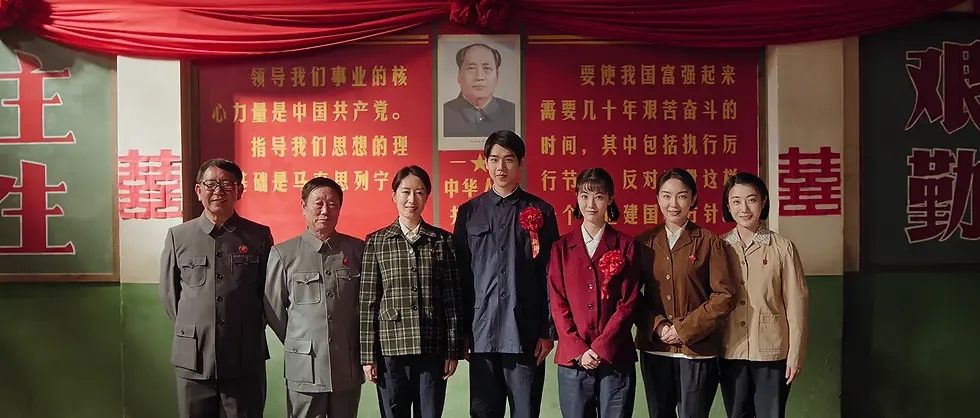
A Puppy Dog Love Story That Won Me Over
Fang Mu Yang (ML) and Fei Ni (FL) stole my heart as individuals and I warmed up to them as a couple by the end. I'm not really a fan of Arthur Chen's acting, but he inhabited old man energy quite nicely and it fit the time period. However, maybe it's just a "me" thing, but I haven't felt his chemistry with any of his co-stars in past dramas, and it remained the same here. That being said, I was able to get behind the love story when I accepted that the two were just naive young people experiencing first love. I kept waiting for the love to mature, but it never grew out of the "young love" phase. I could also just be a hater due to my advanced millennial years, but by the end I could concede that the devotion and sacrifices of the two made up for the lack of chemistry.
I included the picture of Arthur Chen and the carrot because I am confused. Why was in this in the promotional photos? Why is he holding a carrot? How did he keep such a straight face while holding the carrot? I have so many questions and no answers.
The Side Characters
Speaking of love stories, the 2nd couple had way more chemistry than the lead couple. Fang Mu Jing (2FL) was a fascinating character and I loved her growth. She was only cold and calculated out of necessity. Her character was a (albeit softened) good representation of the toll the system had on the psyche of individuals.
Their storyline was an interesting look at how marriage wasn't based on love in the work unit system.
Fei Nei's brother drove me nuts. His loosey goosey behavior with his job stressed me out. Follow your dreams by all means, but he was playing fast and loose in some uncertain times lol. As annoying as he may have been, his storyline was an interesting peek behind the curtain at how hard it was to survive outside the "factory" system.
I loved Xu Hong Qi (Factory leader). She cracked me up and I loved her growth. She had me crying by the end. Ling Yi was also an interesting character whose ambiguity was fascinating. She and Feng Lin were definitely antagonists, but I wouldn't call them actual villains.


The Setting Was the Best Part
The setting of the Cultural Revolution was so interesting. I'm not super familiar with that era, so the drama was a great introduction to how society worked at that time. The Factory itself felt like an eerie, dystopian main character and the social ecosystem was eye opening. I can't imagine living with that level of suspicion and community policing. I will never call my neighbors nosy again. It should be noted that even though hardships were portrayed, the experience of those living in work units was SO much worse than what was shown. The psychological and physical trauma of the work unit survivors far outlasted the systems they suffered from. But when you are aiming to tell a story in the time of the cultural revolution with the constrains of modern day censorship, I understand that the writer and director had to cushion the narrative considerably, and water down historical events so it will fit through the cracks and air on television.

Final Thoughts:
I wholeheartedly recommend! Some arcs worked better than others, and I don't get why Fei Ni practically forgot about University for a chunk of the show, but overall it was such a worthwhile watch! I did laugh at the fact that whoever wrote this show does not know how earthquakes work, which in year of our lord, AI, is a bonafide decision. Be warned there are dallops of propaganda ep 23 onwards. The Male Lead literally becomes a professional propogandist lol, but the focus is more romance and vibes than politics. Overall, the drama was wholesome, the predicaments of the time fascinating, and the love story, while set in the 1970's, was timeless.

RBTS Overall Rating: 4.2 | ||
Story Quality: | 4.5 | Amazing-- It was so interesting but I docked a point because there were some areas that could have been tighter. |
Acting: | 3.75 | Solid-- Peace and Blessings but the ML actor did not inherit the acting skills of his mother. |
Production Quality: | 4 | Good-- I can't speak to the authenticity of the costumes and sets but they looked good to me! |
Ending: | 4 | Acceptable but the antagonists really took an L |
Enjoyability: | 4.5 | Really enjoyed. I don't think I skipped at all. |
Love Story in the 1970's Trailer:
Director: #ChenChang (Love's Ambition, A Chan)
Screenwriter: #GuoShuang (The Miracles, The Love You Give Me, Rememberance of Things Past)

*Disclaimer: I do not own any of the images used on this blog. All images belong to their respective copyright holders and are used for commentary and review purposes. All reviews, opinions, and statements expressed on this blog are my own and are intended for entertainment and informational purposes only. They reflect my personal thoughts and interpretations and should not be considered as factual.


Comments